Strengthening AI Liveness Detection via Commercial Synthetic Media & Audio
How Nextura.ai helped a global biometric security leader stay ahead of commercial-grade synthetic media.
When synthetic media caught up with liveness checks
By late 2025, the gap between what commercial generative AI tools could produce and what biometric liveness systems were trained to catch had effectively closed. A single reference photo was enough to generate a convincing talking video with correct facial geometry, natural micro-expressions, phoneme-accurate lip-sync — even a cloned voice reading back a spoken passphrase. For a global leader in AI-driven biometric security, that shift mattered directly: their liveness detection models had been built and validated against real human captures and legacy presentation attacks — printed photos, paper masks, screen replays. Multi-modal, AI-generated spoofing was a different animal entirely, and it wasn't hypothetical anymore. It was available off the shelf.
The client came to Nextura.ai with a clear ask: stress-test their authentication models against the same commercial tools a real attacker would use, across both video and voice, and do it fast enough to inform an active product roadmap.
Why this was hard
The difficulty wasn't generating synthetic media — that part is commoditized now. It was generating synthetic media that was adversarially useful: realistic enough to genuinely test the model, controlled enough to be usable as labeled training data, and diverse enough to cover how liveness checks actually get attempted in the wild.
That meant holding several things true at once: preserving a subject's facial identity and voice characteristics through motion and speech, reproducing the small physical signals liveness systems look for (depth shifts as someone leans toward a camera, natural blink rates, ambient acoustic texture behind a voice), and doing all of this across a genuinely wide demographic and environmental spread. It also meant catching what generative tools get subtly wrong — a frame that morphs half a second too long, a voice that's a half-tone too clean — before any of it reached a training set. Get that filtering wrong, and you're not testing the model against reality; you're testing it against artifacts.
A multi-modal generation & validation pipeline
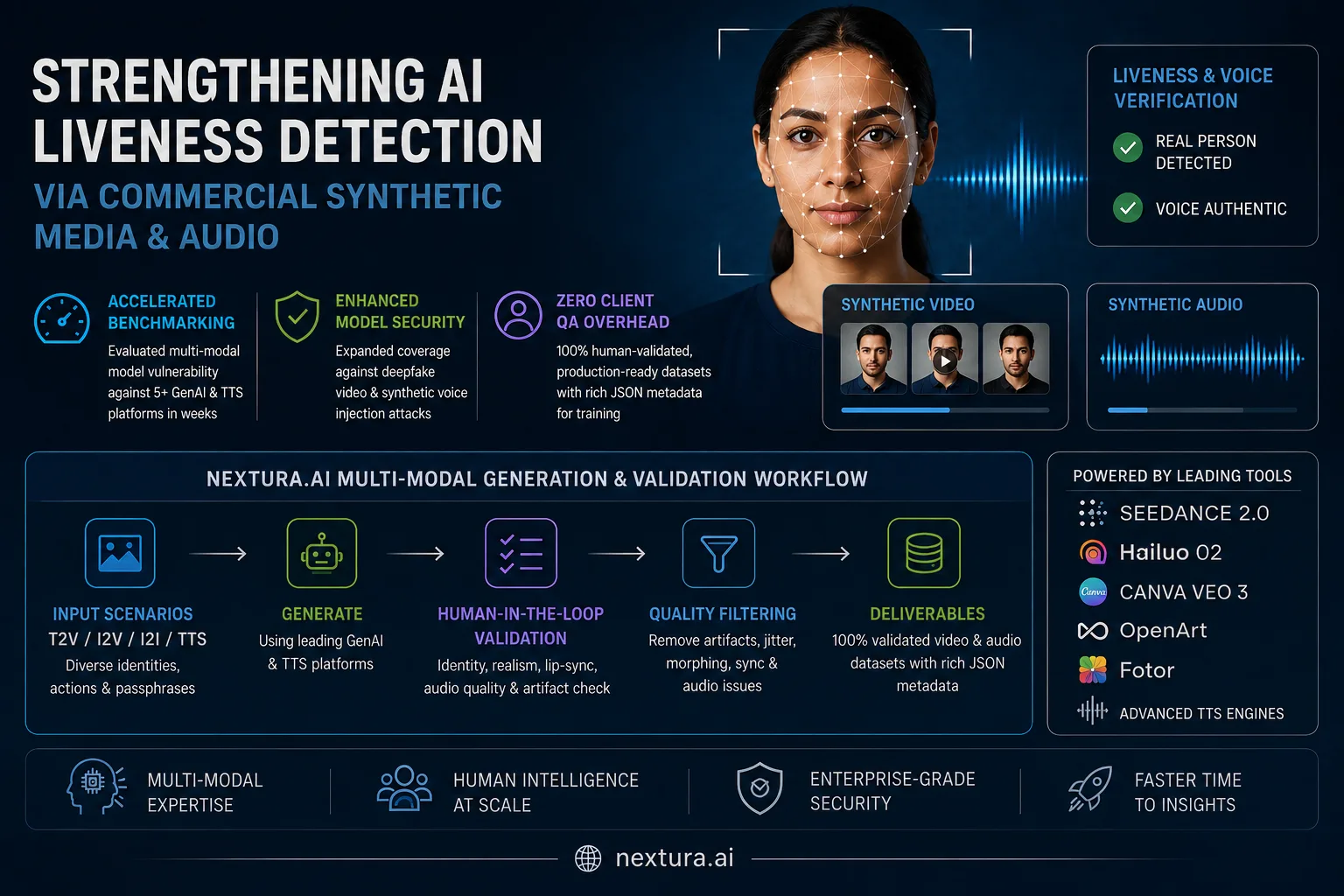
Nextura.ai ran this as a multi-modal generation and validation pipeline spanning Text-to-Video (T2V), Image-to-Video (I2V), Image-to-Image (I2I), and Text-to-Speech (TTS), using a working stack of leading commercial tools rather than a single vendor — because a model that only fails one generator's fingerprint hasn't really been tested.
The generation itself was structured, not improvised. We built a prompting matrix around ten distinct narrative structures — the kinds of interactions a liveness check actually walks a user through — and crossed them against wide candidate pools spanning ancestry, age, environment, lighting, and spoken accent or language, so the resulting dataset reflected how the client's real user base actually looks and sounds, not a narrow synthetic slice of it.
Every asset that came out of that pipeline was then manually reviewed, in full. Our HITL pods checked for identity and voice consistency across frames, natural audio-visual sync, and the telltale artifacts of AI generation, before anything was packaged to the client's technical spec (sub-10-second clips, sub-10MB payloads, vertical portrait format) with complete JSON metadata attached for immediate ingestion into their training pipeline.
What it meant for the client
| Outcome | Result |
|---|---|
| Accelerated benchmarking | Evaluated multi-modal model vulnerability against 5+ commercial GenAI & TTS platforms in weeks — not the months a physical capture campaign would require |
| Enhanced model security | Expanded coverage against deepfake video and synthetic voice injection attacks across a wide demographic and environmental spread |
| Zero client QA overhead | 100% human-validated, production-ready datasets with rich JSON metadata, packaged to spec (sub-10s clips, sub-10MB, vertical portrait) for immediate ingestion |
The headline result was speed: benchmarking model vulnerability across five-plus commercial GenAI and TTS platforms in weeks rather than the months a physical capture campaign would have required. But the more durable value was coverage — the client's Data Science team could now stress-test against modern multi-modal spoofing (video and voice injection together) without ever running a physical shoot, and could ingest what we delivered directly, with zero data-cleaning overhead on their end.
Why clients bring this work to Nextura.ai
This kind of engagement sits at the intersection of a few disciplines that don't usually live under one roof — prompt engineering, computer vision, speech and language AI, and adversarial red-teaming — and we run it through dedicated HITL pods built to deliver clean, verified data at scale rather than one-off samples. All of it operates inside an enterprise security posture aligned to ISO 27001, SOC 2, and GDPR, with strict PII and data-isolation controls, because adversarial datasets involving real human likeness and voice carry their own governance weight.