Building the Ears for Real-Time AI
Curating 4,000 hours of multi-lingual speech and acoustic data for streaming ASR.
Two problems, one waveform
A global AI leader needed to train a real-time streaming speech recognition and live-captioning system to do two things simultaneously: transcribe speech accurately across multiple languages, and correctly identify what was happening acoustically around that speech — a siren in the background, a doorbell, an IVR tone, a cough mid-sentence. Getting both right, in real time, meant the training data itself had to be built to a precision standard well beyond typical transcription work. Nextura.ai was brought in to source, transcribe, and annotate roughly 4,000 hours of that data.
Why this was hard
Streaming ASR doesn't forgive the shortcuts that offline transcription tolerates. The audio had to stay untouched — no clipping, splicing, or lossy resampling — because the model needed to learn from continuous, real-world waveforms exactly as a live microphone would capture them. Every speech and acoustic event inside those waveforms then needed frame-accurate annotation at 10-millisecond resolution, including cases where a siren overlapped a sentence rather than following it — a materially harder labeling problem than tagging clean, sequential events.
Layered on top of that were two constraints that don't trade off against each other: full PII redaction across every transcript and file to meet global privacy requirements, and broad demographic coverage — age, gender, accent — across a wide range of real recording environments.
An end-to-end speech & acoustic pipeline
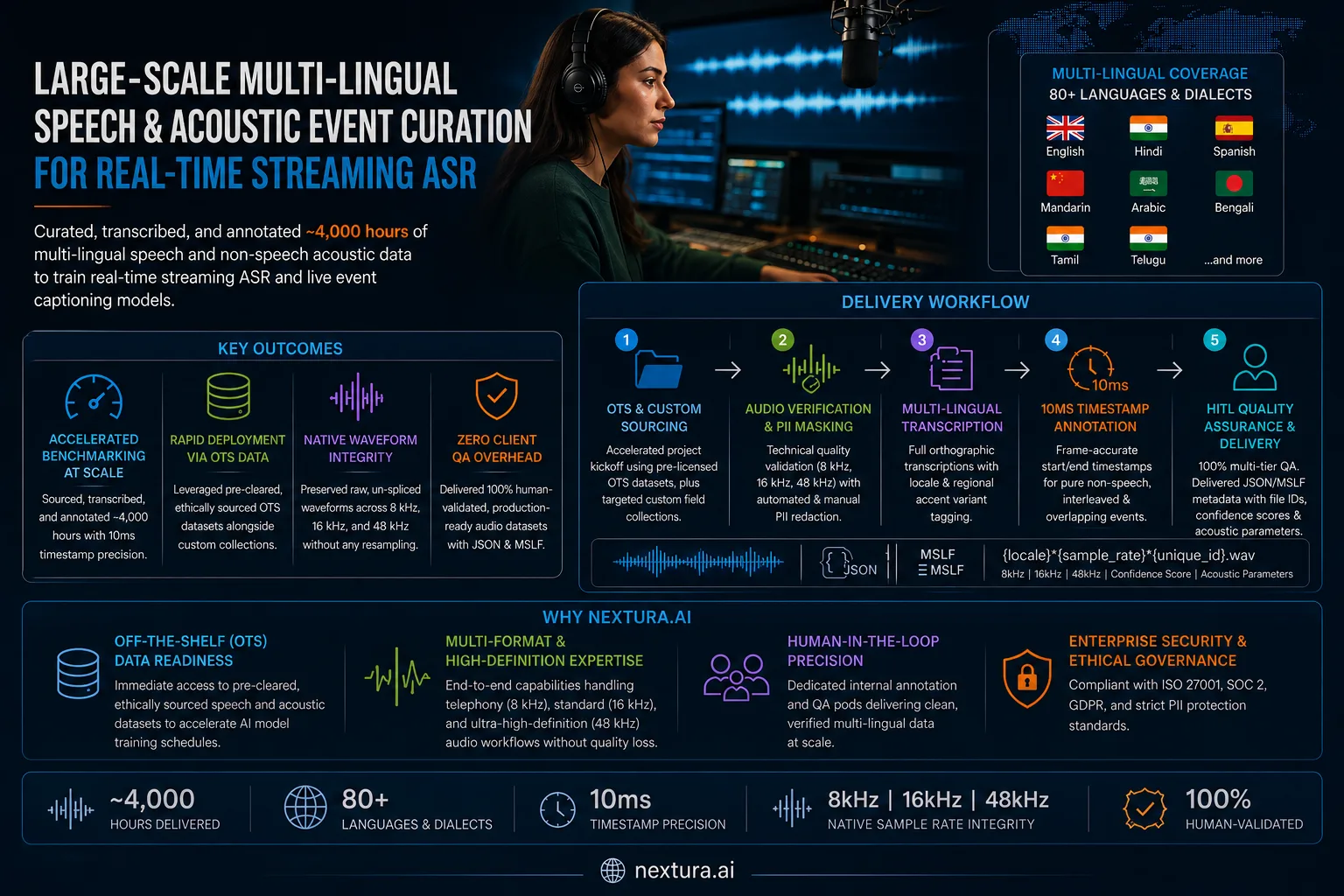
Nextura.ai ran this as an end-to-end sourcing, transcription, and annotation pipeline spanning 34 distinct sound-event classes across ten Tier-1 global languages and their regional variants.
We accelerated the front end by combining pre-licensed, ethically sourced off-the-shelf datasets with targeted custom field recordings, rather than starting from zero. Every file then went through technical verification across its native sample rate — 8 kHz telephony audio, 16 kHz standard, and 48 kHz high definition — paired with PII redaction and sanitization before transcription began. Transcription itself carried full orthographic detail with local and accent-variant tagging, and every speech and acoustic event, including overlapping ones, received frame-accurate 10ms timestamps. The full set moved through multi-tier internal QA before delivery, packaged with standardized JSON and MSLF metadata, unique file identifiers, confidence scores, and acoustic parameters built to be ingested directly into model training — not reprocessed first.
Accelerated project kickoff using pre-licensed OTS datasets, plus targeted custom field collections.
Technical quality validation (8 kHz, 16 kHz, 48 kHz) with automated & manual PII redaction.
Full orthographic transcriptions with locale & regional accent variant tagging.
Frame-accurate start/end timestamps for pure non-speech, interleaved & overlapping events.
100% multi-tier QA. Delivered JSON/MSLF metadata with file IDs, confidence scores & acoustic parameters.
What it meant for the client
| Outcome | Result |
|---|---|
| Production-ready dataset at scale | ~4,000 hours of fully validated, multi-lingual audio delivered — native waveform integrity preserved across all three sample rates, zero splicing or resampling artifacts |
| Zero client QA overhead | Multi-tier internal QA completed before delivery, so the client's team moved straight from delivery to training — no reprocessing, no data-cleaning burden on their side |
| Training-ingestable packaging | Standardized JSON and MSLF metadata, unique file identifiers ({locale}_{sample_rate}_{unique_id}.wav), confidence scores, and acoustic parameters built for direct model ingestion |
The client received a fully validated, production-ready multi-lingual audio dataset at genuine scale — native waveform integrity preserved across all three sample rates, zero splicing or resampling artifacts, and no QA burden left on their side. That let their team move straight from delivery to training.
Why clients bring this work to Nextura.ai
Few partners can move as fast on off-the-shelf (OTS) data readiness while still holding a 10ms annotation standard across 8 kHz-to-48 kHz audio without quality loss. That combination — pre-cleared data access, multi-format audio depth, and dedicated HITL annotation pods — is what let us handle both scale and precision on the same engagement, under governance aligned to ISO 27001, SOC 2, GDPR, and strict PII protection standards.